Vendor Lock-In Is the Hidden Cost of Your "Cheap" Website
Here's What It Actually Costs You.
Most businesses don't find out they don't own their website until the moment they try to leave it.
Last updated
Most businesses don't find out they don't own their website until the moment they try to leave it.
That's the trap. Lock-in is invisible while you're happy. It only becomes visible the day you want a new developer, a faster host, a different feature — and discover the agency that built your site is the only one who can touch it, the CMS is theirs not yours, or the "website" you paid for is actually a rented seat on someone else's platform.
This isn't a Dubai-specific problem, but it's an underdiscussed one in a market where most agencies quote a price and never mention what happens after the invoice clears. Here's what lock-in actually is, what it costs, and how to check whether it's already happened to you.
What vendor lock-in actually means
Vendor lock-in is any situation where switching away from your current website provider — a platform, an agency, a host — costs significantly more than it should, because something essential is controlled by them and not by you.
It's not always obvious, because lock-in doesn't announce itself. No agency tells you upfront "you will not be able to leave us without rebuilding from scratch." It just becomes true the day you try. Which is why "no vendor lock-in" as a sales claim is worth testing against specific questions rather than taking at face value.
The test is simple: if your current provider disappeared tomorrow, could someone else pick up exactly where they left off? If the honest answer is no, you're locked in — whether or not anyone called it that.
The four most common forms it takes
1. Closed-platform lock-in. Website builders like Wix and Squarespace are the clearest example. Your site exists inside their platform — there's no exportable codebase to take elsewhere. If you stop paying, the site goes dark. If you want to leave, you're rebuilding from zero on a new platform, not migrating.
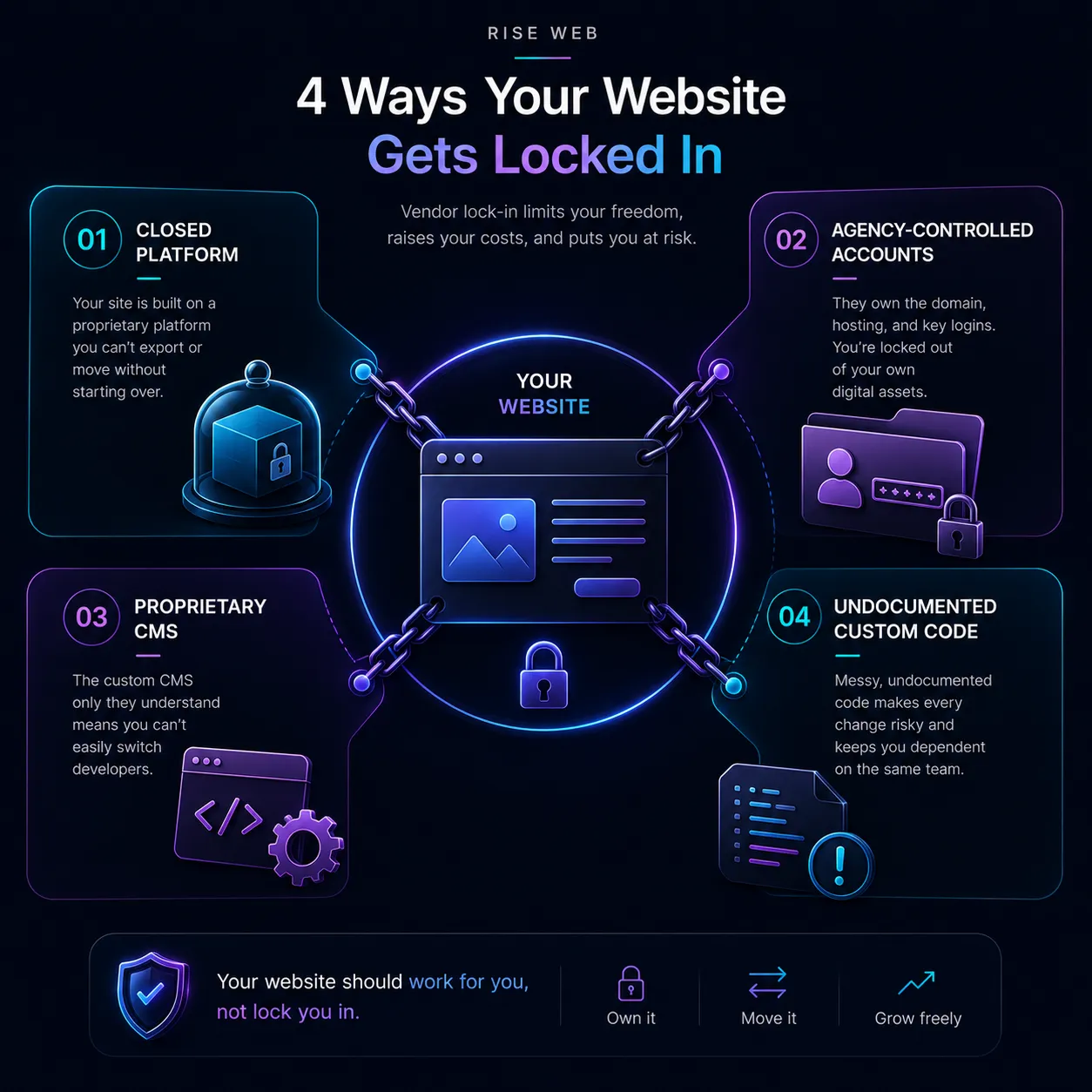
2. Agency-controlled accounts. Some agencies register your domain, hosting, and CMS accounts under their own business name or login, "to make it easier to manage." That convenience becomes leverage: if the relationship ends badly, getting access back can take weeks of disputes, or never happen at all.
3. Proprietary CMS lock-in. A handful of agencies build on an in-house content system nobody else can edit. Every future change — even a typo fix — has to go through them, at their hourly rate, forever. There's no migration path because there's nothing standard to migrate.
4. Undocumented custom code. Even a fully custom build can lock you in if there's no documentation and the original developer is the only person who understands how it works. Technically you "own" the code; practically, nobody else can maintain it without a costly audit first.
What it costs you, concretely
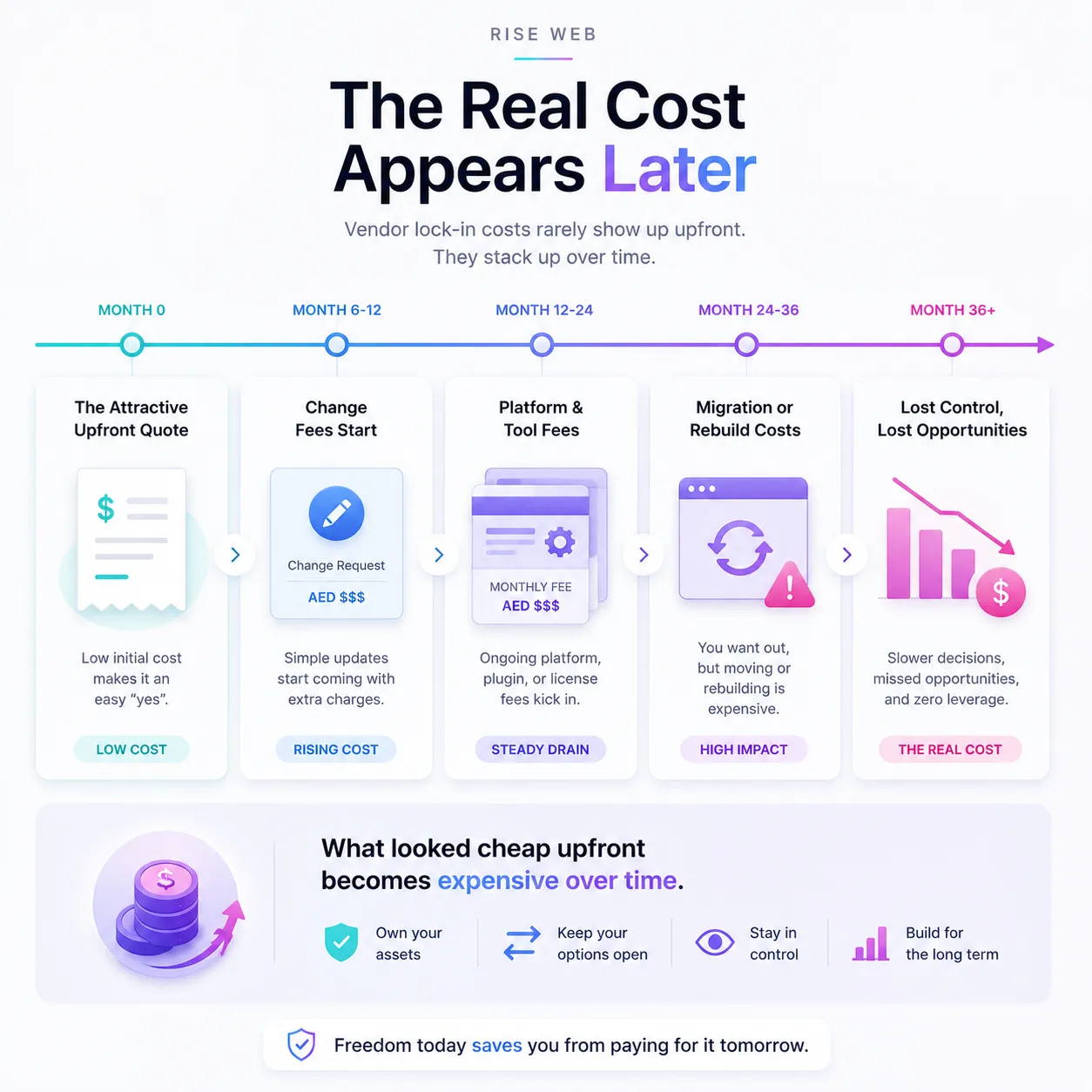
Lock-in rarely shows up as a single bill. It shows up as a pattern of small, recurring costs that wouldn't exist if you actually owned your infrastructure:
- Negotiating leverage disappears. When a developer knows you can't leave, pricing for "small" change requests tends to drift upward. You have no real alternative to compare against.
- Downtime risk on someone else's schedule. If your agency goes quiet, gets acquired, or simply stops responding, your site's fate is tied to a business relationship you don't control.
- Migration becomes a rebuild. Leaving a closed platform isn't "moving" a website — it's building a new one from scratch, at full project cost, because nothing transfers.
- Compounding platform fees. Per-seat CMS pricing, transaction cuts on e-commerce, "premium" feature paywalls — these tend to increase over the life of the relationship, not decrease.
- No second opinion possible. Want another developer to quote a fix or an upgrade? They can't, because they can't see or access the system the first one built.
None of this shows up on the original invoice. It shows up 12, 24, or 36 months later, exactly when you have the least leverage to do anything about it.
How to check if you're already locked in
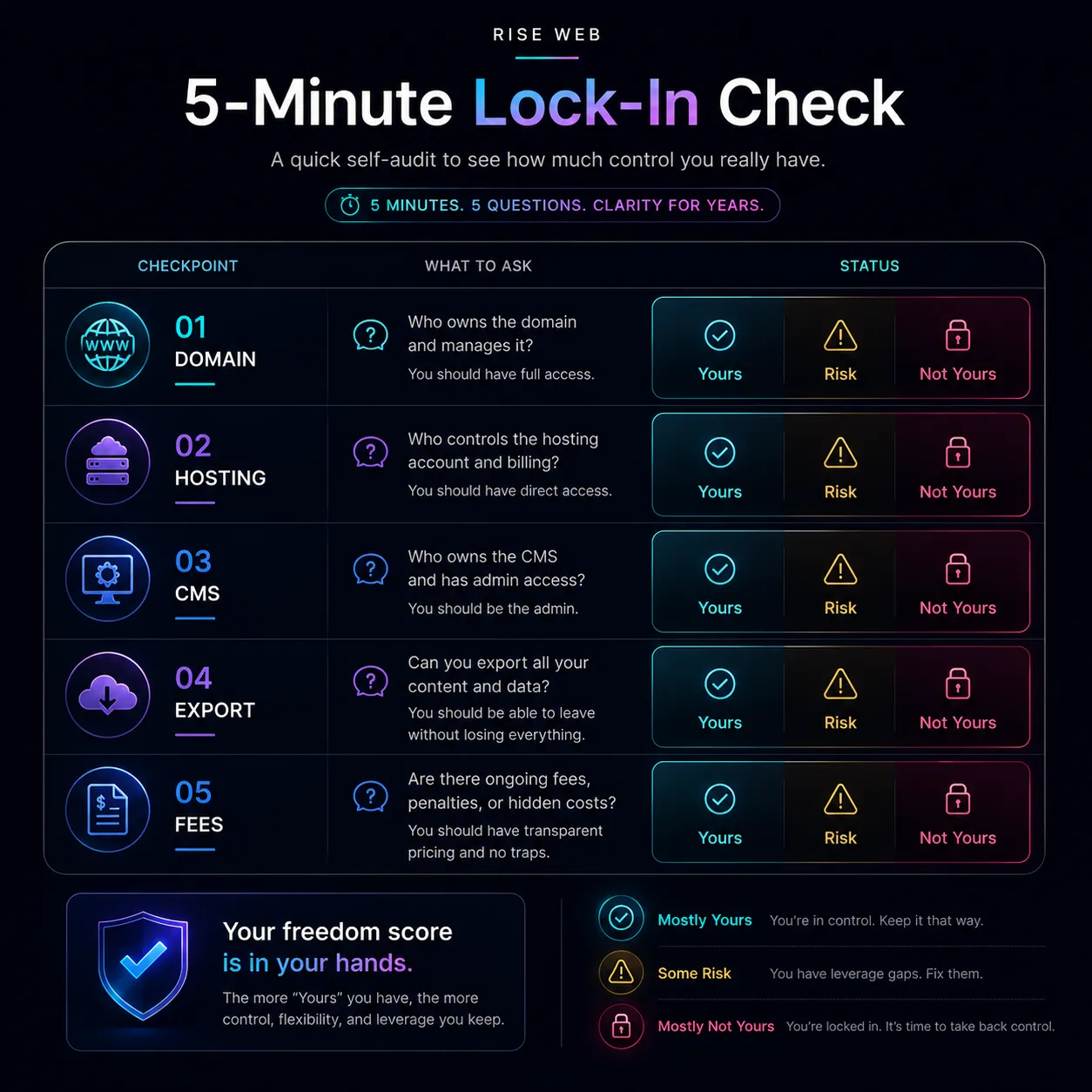
Five direct questions, answerable in a few minutes:
- Whose name is the domain registered under? Check via your domain registrar or a WHOIS lookup. It should be yours, not your agency's.
- Can you log into your hosting account directly, right now, without asking anyone? If the answer is "I'd have to ask [agency]," that's lock-in.
- Is your CMS something a different developer could open and recognize? Payload, WordPress, and most mainstream open-source CMSs qualify. A custom in-house panel with no documentation does not.
- If you exported everything today, would you have a working website, or a pile of files nobody can use? Real ownership means a second developer could pick it up cold.
- Are you paying recurring platform fees that scale with growth, and would they continue even if you switched developers? If yes, you're paying rent on infrastructure, not owning an asset.
If two or more of these come back as a problem, you're not just inconvenienced — you're structurally dependent on a single provider for something you should control yourself.
What "owning your stack" actually means
At RISE Web, every build runs on an open-source stack: Next.js for the frontend, Payload CMS for content, Twenty CRM for leads, Umami for analytics, and a handful of other open tools — all deployed under your accounts, not ours.
Concretely, that means:
- Your domain, your hosting account, your CMS login — from day one, not handed over reluctantly at the end of a dispute.
- A standard, documented stack — any competent developer familiar with Next.js and Payload can pick up where we left off, because nothing about the build is proprietary or hidden.
- No per-seat CMS fees, no transaction cuts — the tools we use are open-source by design, so there's no recurring platform tax baked into your monthly costs beyond the hosting you actually use.
- A real exit, not a threat. If you want to switch developers next year, you can. That's not a hypothetical we hope you never test — it's how every project is built.
This is also why our pricing looks different from a typical Dubai quote — see How Much Does a Website Cost in Dubai? for the full breakdown of what's actually included.