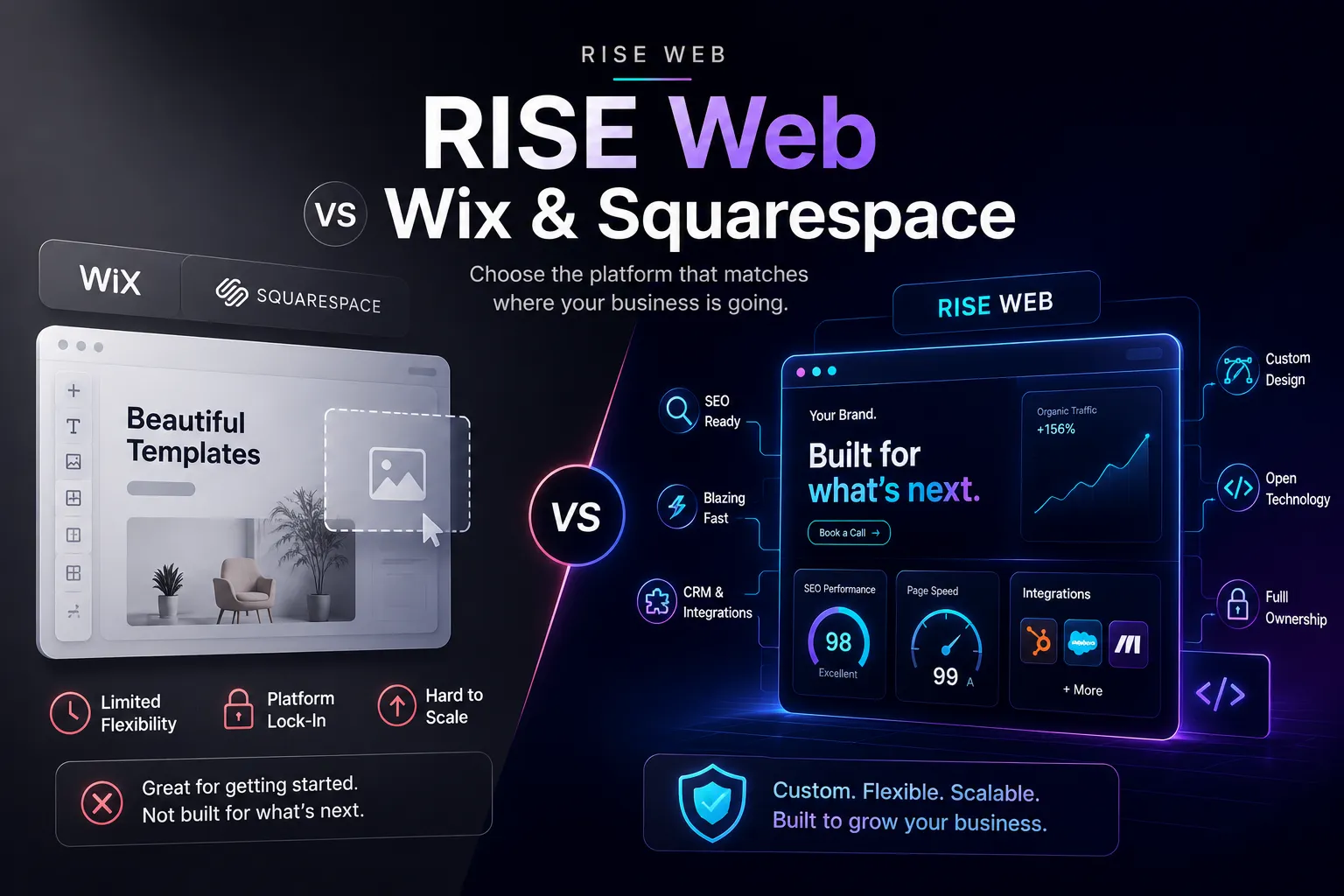
RISE Web vs Wix and Squarespace: Which One Wins?
An honest look at when DIY builders are genuinely the right call, and when they quietly become an expensive mistake
If you're comparing RISE Web to Wix or Squarespace, the honest answer is: it depends entirely on what you're building and where you want to be in two years.
Last updated
Most comparison articles between website builders and custom developers are written by one side trying to talk you out of the other. This one isn't. Wix and Squarespace are well-built products used by millions of businesses for good reason. The real question isn't "which is better" in the abstract — it's whether your business's growth plans match what the tool was built for.
Table of Contents
- When Wix and Squarespace Genuinely Make Sense
- Where the Ceiling Shows Up
- Side-by-Side Comparison
- What Switching Later Actually Costs
- How to Decide
When Wix and Squarespace Genuinely Make Sense
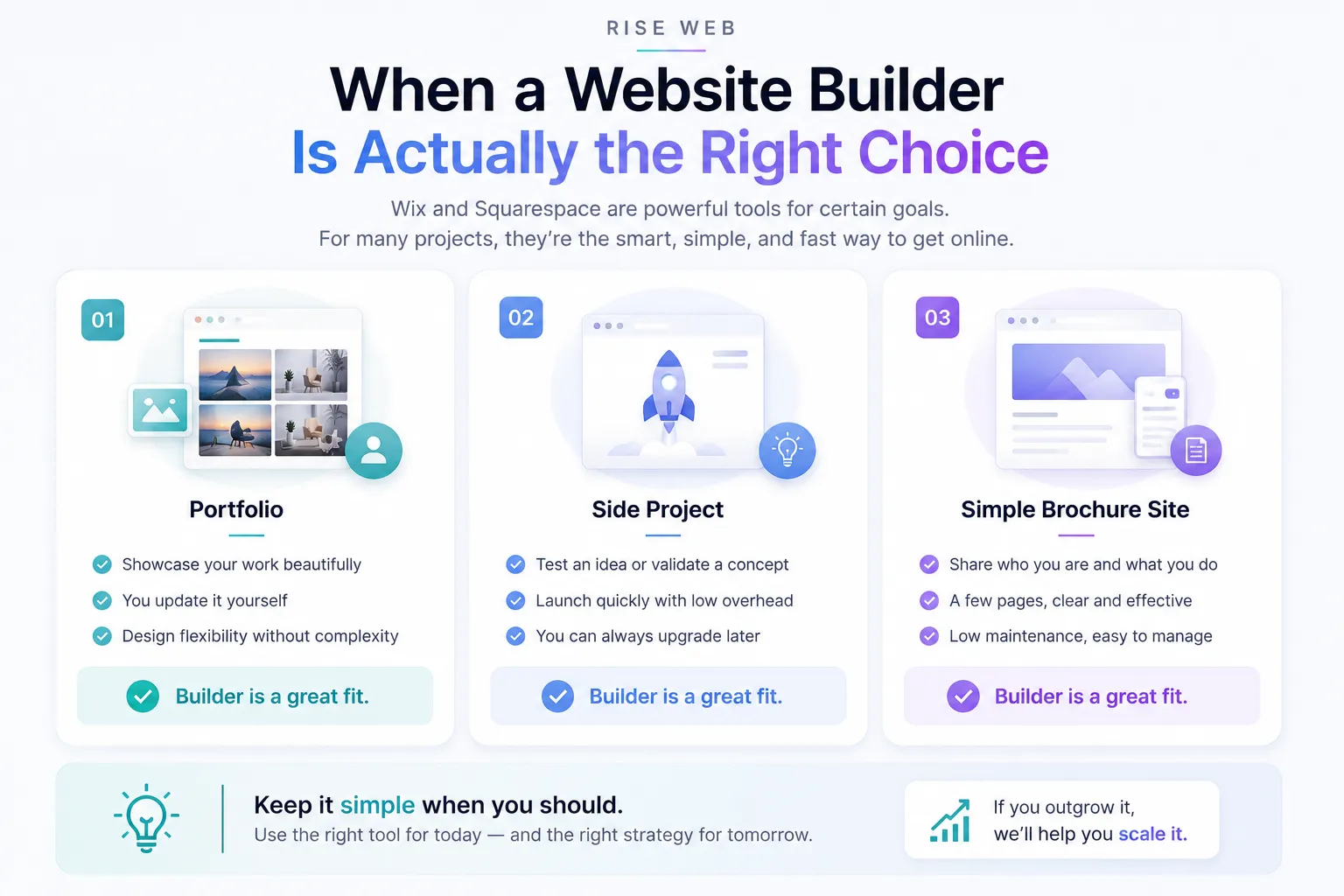
There are real, defensible use cases where a website builder is the correct choice — not a compromise, the correct choice.
A personal portfolio with no business model behind it. A photographer, designer, or writer showcasing work with no e-commerce, no lead capture funnel, and no plan to scale traffic acquisition. Squarespace's templates are genuinely beautiful for this. You're paying for design polish and zero maintenance, and that's a fair trade.
A true side project. If you're testing an idea, running it as a hobby, or validating demand before committing real money, spending $16–$40/month on Wix to get something live in a weekend is smarter than commissioning custom development for an idea that might not survive contact with the market.
A pure brochure site with zero growth ambition. A small local business — a single-location bakery, a retiring tradesperson, a community group — that wants a digital business card and has no interest in ranking competitively, running campaigns, or integrating systems. If the site exists so people can confirm you're real and find your phone number, a builder does that job completely.
In all three cases, paying a developer for custom work would be over-engineering. We'd tell a client this directly if they asked.
Where the Ceiling Shows Up
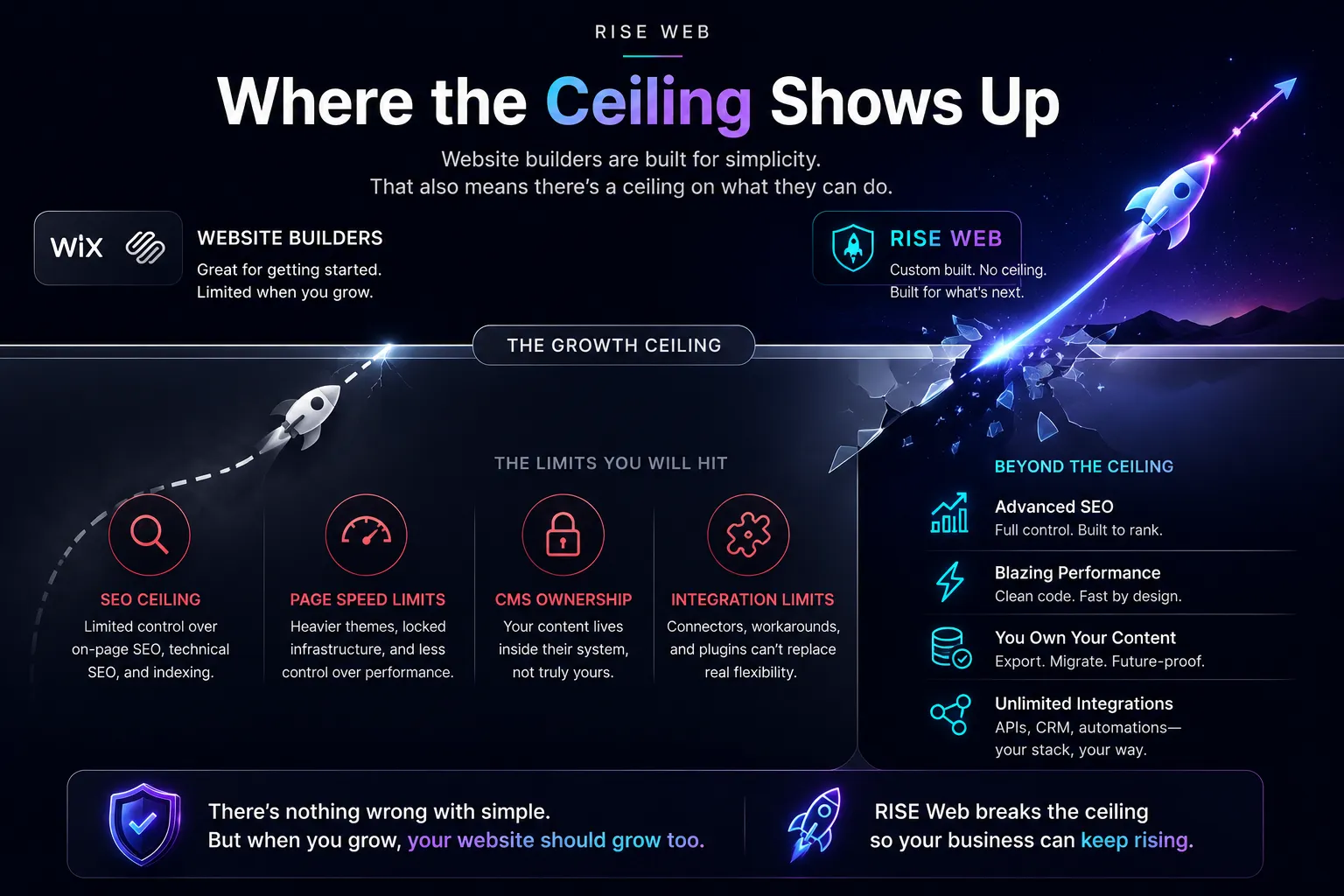
The problems with website builders aren't visible on day one. They show up 12–24 months in, exactly when a growing business needs its website to do more.
SEO ceiling. Wix and Squarespace have improved their technical SEO significantly over the past few years — they're no longer the disaster they were in 2015. But you still don't control the underlying HTML output, can't easily implement custom schema markup beyond what the platform exposes, and have limited control over render performance, which Google's Core Web Vitals weighs directly in rankings. For a business in a competitive local market — real estate, healthcare, legal, anything with paid competitors fighting for the same keywords — this ceiling matters.
Page speed limits. Builder platforms load substantial JavaScript and CSS frameworks regardless of what your specific page needs, because they're built to support every possible template and widget combination. A custom-built site loads only what your page actually uses. The difference shows up directly in Largest Contentful Paint and mobile load times, both ranking factors.
No real CMS ownership. Your content, your design, and your data live entirely inside Wix's or Squarespace's infrastructure. You can export some content, but you can't export the site — the templates, the custom logic, the integrations you've built up over years. If the platform changes its pricing, deprecates a feature you depend on, or you simply want to leave, you are starting over, not migrating. We've written a full breakdown of what vendor lock-in actually costs if you want the mechanics.
Integration limits. Connecting a real CRM, a booking system with custom logic, or a multi-step lead qualification flow is possible on these platforms via their app marketplaces, but you're working within someone else's API constraints, paying recurring app fees, and accepting their performance and support trade-offs.
Side-by-Side Comparison
| Factor | Wix / Squarespace | Custom Build (RISE Web) |
|---|---|---|
| Upfront cost | Low ($0–$500 setup) | Higher (fixed-price packages, see /packages) |
| Monthly cost | $16–$50/mo platform fee, plus paid apps | Hosting only, typically lower long-term |
| Ownership | Platform-locked, no code export | Full code and content ownership |
| CMS flexibility | Template-bound, limited custom fields | Fully custom content models |
| SEO ceiling | Good for basics, capped for competitive niches | No structural ceiling |
| Page speed | Constrained by platform framework | Built lean for your actual content |
| Scalability | Hard limits on complex logic, multi-step flows | Scales with custom code, no plugin bloat |
| Support model | Platform help center, community forums | Direct relationship with your developer |
Neither column is "wrong." They're optimized for different jobs.
What Switching Later Actually Costs
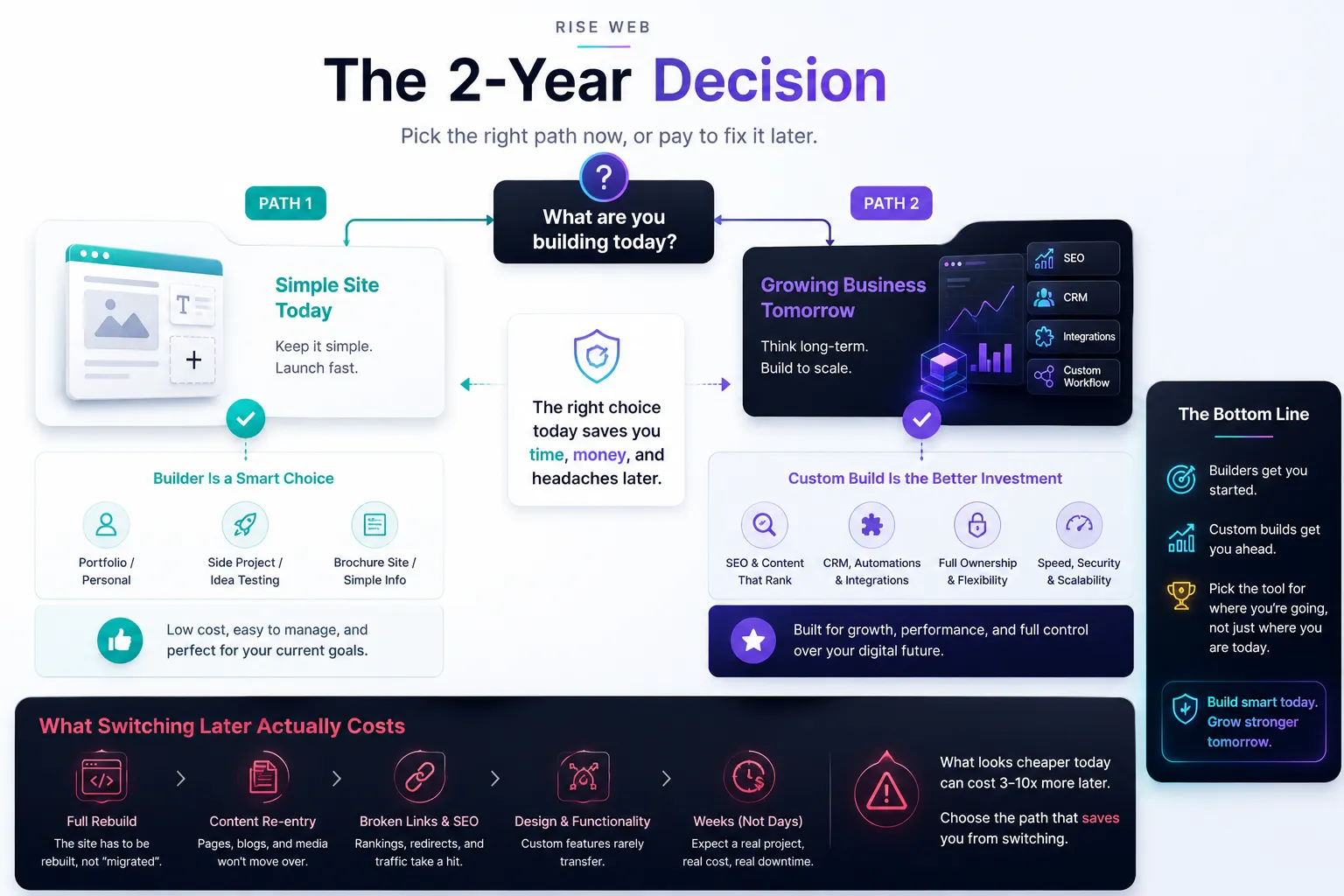
This is the part most businesses don't calculate until it's too late. Moving off Wix or Squarespace after two or three years isn't a settings change — it's a full rebuild. You lose your URL structure unless someone manually maps every redirect, which means losing accumulated SEO authority if it's done sloppily. You lose your content unless it's manually re-entered into the new system. You lose any custom design work entirely, because it doesn't exist outside the platform's editor.
The businesses that get hurt worst by this are the ones who picked a builder for a "starter site" and then grew faster than expected — they end up paying for a full rebuild at the exact moment they have the least time to manage one. We go into the specific cost mechanics of this in our piece on vendor lock-in.
How to Decide
Skip the marketing copy from either side and ask three questions honestly:
- Will this site need to integrate with other business systems within two years — a CRM, a booking engine, a custom lead flow? If yes, a builder will eventually become a bottleneck.
- Is organic search a real part of your growth strategy, or is the website mainly a digital business card for people who already know you? If SEO is core to how you get customers, the ceiling matters more.
- Do you expect to outgrow the current version of this site in under two years? If you're not sure, that uncertainty itself is useful information — it usually means yes.
If you already have a Wix or Squarespace site and you're trying to figure out whether you've hit the ceiling, the fastest way to find out is to look at the data rather than guess. Our free Website Health Check gives you a clear read on your current site's performance, SEO gaps, and technical issues — no sales pitch, just a diagnostic you can act on either way. You can also see exactly what a custom build is built on at /stack. Before you commit either way, it's worth being clear on what "no vendor lock-in" actually means — on a builder platform, the answer is rarely what owners assume.